
ISCRE 25: International Conference on Chemical Reaction Engineering
28 May, 2018
CIES 2018 CONFERENCE
26 June, 2018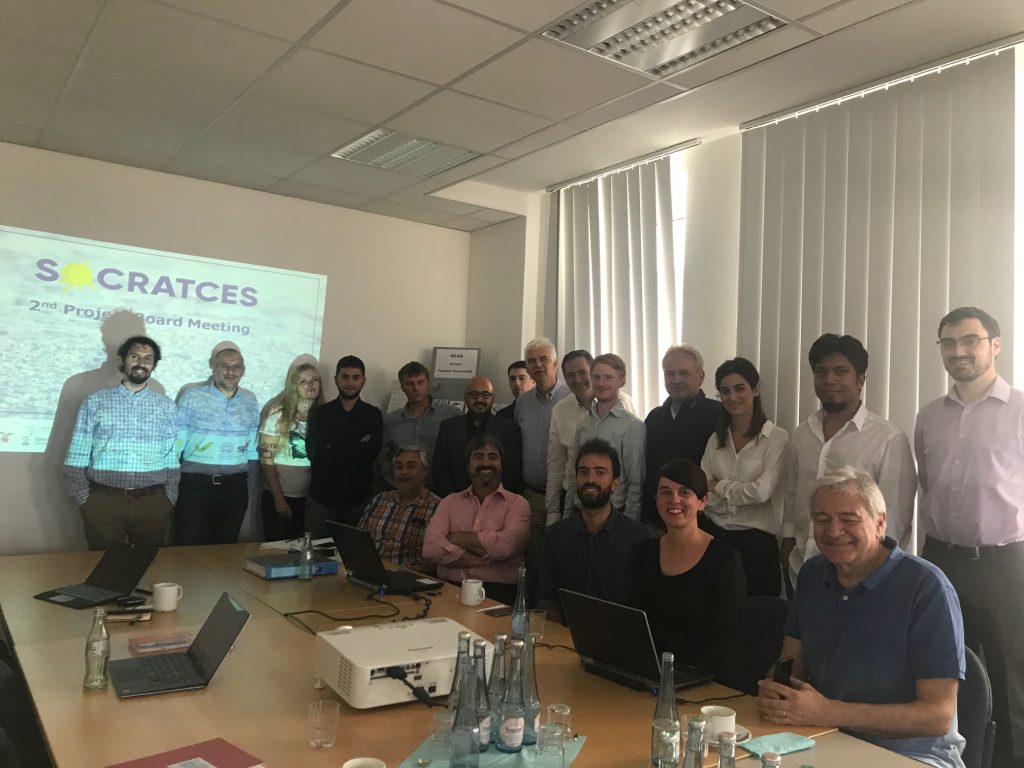
Most significant results achieved so far in the SOCRATCES project
Seville, June 5th 2018
The University of Seville coordinates the meeting that takes place this week at the scientific research institute of TTZ Bremerhaven, Germany
The University of Seville coordinates the meeting that takes place in the scientific research institute of TTZ Bremerhaven (Forschungsinstitute - Bremerhaven - Germany) on June 6 and 7 of the SOCRATCES project (SOlar Calcium looping integRAtion for Thermochemical Energy Storage ( https: // socratces .eu /) in which the most significant results achieved so far will be presented, and the following actions will be defined to begin with the tasks of engineering and prototype construction in 2019.
The SOCRATCES project, coordinated by the University of Seville since January 2018, has a total duration of 3 years and focuses on the development of a new concept of concentrated solar thermal energy storage -CSP- through the process of Calcium-Looping. This process is based on the reversible reaction of calcination-carbonation of calcium carbonate (CaCO3). The concentrated solar energy is used to carry out the endothermic reaction of calcination and the products, calcium oxide (CaO) and CO2 are stored. Subsequently, to release the energy stored in the chemical bonds, these products are taken to a reactor where the opposite exothermic reaction, carbonation, takes place. This process of carbonation releases the energy stored in the bonds, generating heat at a high temperature that can be used for the production of electrical energy.
Among the advantages of the system to be developed are the use of Caliza as the main material, the high expected performance of the system in its stage of technological maturity and the storage capacity of energy for long periods of time. The limestone is composed mainly of calcium carbonate (CaCO3), very low cost material, non-toxic and widely available, is one of the most abundant materials on the planet. The high expected performance of the system is based on the very high energy density of the system and the high temperature achievable in the exothermic reactions. Long-term storage is associated with the stability of the bonds in the products of calcination.
The final prototypes of the project will be installed in Seville.
The SOCRATCES project is funded under the H2020 program of the European Commission with a budget of € 4,994,152. The consortium is composed of 14 entities, universities, research centers and companies from 7 European countries.
Contact information: Ricardo Chacartegui. Energy Engineering department.
ricardoch@us.es // 954487243 // 608 66 51 85
Fuente: Vicerrectorado de Investigación
UCC+i Universidad de Sevilla
comunicacioninves@us.es
Tlfn: 954550123
Móvil: 682014434