
CIES 2018 CONFERENCE
26 June, 2018
SOCRATCES at SOLARPACES 2018 – Casablanca (Morocco)
12 September, 2018
The PRES2018 and CHISA2018 Conference in Prague
The 21st Conference on Process Integration for Energy Saving and Pollution Reduction - PRES 2018, was held in August 25th -29th, 2018, in Prague, Czech Republic, and was co-organized with the 23rd International Congress of Chemical and Process Engineering.
PRES conference covers a range of important topics and, together with the CHISA conference offer many real interdisciplinary links.
The Congress is structured as follows
- CHISA 2018 – General topics of chemical and process engineering
- CHISA 2018 – Specialised symposia
- PRES 2018 – 21st Conference on process integration, modelling and optimisation for energy saving and pollution reduction
- Exhibition MARCHES 2018
- EFCE WP Meetings and other agenda
The program covers invited plenary lectures and keynote lectures, parallel lecture sessions, and poster sessions. Some symposia are co-organized with the corresponding EFCE Working Parties and/or other recognized international bodies. The possibility to arrange short courses (mainly after the Congress) is offered.
Original contributions, process applications, case studies, state-of-the-art papers and commercial information on the following subjects are invited.
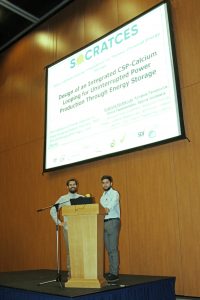 The paper produced within the project SOCRATCES was presented in the PRES 2018 conference held in Prague. SOCRATCES (SOlar Calcium-looping integRAtion for Thermo-Chemical energy storage) project is a European Union research project, funded from Horizon 2020 (G.A. no 727348).
The work presented was prepared by the team of CERTH working on integration options of the concept and was entitled “Design of an Integrated CSP-Calcium Looping for Uninterrupted Power Production Through Energy Storage”. Also, the paper has been published in the journal of Chemical Engineering Transactions (CET) and can be found following this link: http://www.aidic.it/cet/18/70/356.pdf. CET is covered by SCOPUS and ISI Thompson Reuters and is an open access journal.
As Dipl. Chemical Engineer, Evgenios Karasavvas, part of CERTH and SOCRATCES team presented the work focuses on: Solar driven large-scale uninterrupted power production can be accomplished with a combination of Concentrated Solar Power (CSP) plant and a Thermochemical Energy Storage (TCES) based on a Calcium Looping (CaL) process. Thermal energy can be stored in the form of chemical energy due to calcination reaction and released bask as thermal energy during the carbonation reaction (CaO+CO2↔CaCO3).
This paper presents the preliminarily design, integration and simulation of such a process plant in AspenPlusTM considering a novel approach in the manner that solar energy is introduced to the system. This includes the indirect solar heated calcination by explicitly heating up CO2 at high temperatures at a concentrated solar heat exchanger (receiver), where CO2 is directly imported into the calciner not only to preheat solids, but to provide the appropriate energy for the highly endothermic calcination reaction. A global efficiency of the integrated system reaches 31.5 %. A parametric analysis is presented on the effects of key parameters such as the carbonation pressure, the CO2 inlet temperature to calciner and CaO storage temperature.
CHISA 2018 organizer: Professor Jiří Drahoš, Congers chairman, President of the Czech Society of Chemical Engineering (CSCHE)
PRES 2018 organizer: Professor Jiří Jaromír KLEMEŠ, President of Conference PRES